Worship keyboard voicings: chords that stay out of the band's way
How to voice chords on keys in a worship band without stepping on the bass, guitar or vocals: left hand, inversions in C3–C5, voice leading and dynamics by section.
In this article9 sections
- What’s a voicing, and why does it matter in a band?
- What does the left hand do when there’s a bass player?
- How do you voice chords in the right hand?
- What does a typical G–D–Em–C progression look like?
- How do you add color without overloading the chord?
- How do you leave room for the guitar and the vocal?
- How should your voicing change from section to section?
- Common mistakes
- Frequently asked questions
Short answer: in a band, the keys don’t play “the whole chord” — they play the part of the chord nobody else is covering. With a bassist, the left hand stays out of the bass’s way (nothing below C3); the right hand lives between C3 and C5, using triad inversions that move as few notes as possible from one chord to the next, and color comes from an added 2 or a sus2, not stacked extensions. If the guitar is strumming in the middle, the keys move up an octave or switch to a pad; when the lead vocal is singing, leave gaps. And dynamics come from the notes you choose: sparse verse, open chorus, a bridge that builds.
A keys player who sounds great on their own can sound rough in a band. Not because of technique, but because they play like they’re alone: octaves in the left hand, four- or five-note chords in the right, all the time. At home it sounds full; on stage, on top of bass, guitar and vocals, it turns to mud. This guide is about choosing which notes to play — your voicings — so the keys add to the band instead of covering it up. If you’re still picking an instrument and sounds, start with our worship keyboard guide.
What’s a voicing, and why does it matter in a band?
A voicing is the specific way you lay out the notes of a chord: which notes you play, in what order, in which octave. G major is three notes (G, B, D), but you can play it dozens of ways: high, low, spread, close, with the root on top or the third on the bottom.
Playing solo, a pianist picks a voicing for how it sounds. In a band you also have to pick it for where everyone else is. Every instrument takes up a slice of the keyboard, and when two of them play the same thing in the same slice, they don’t add up — they mask each other. Here’s the rough layout in a typical worship band (C4 = middle C):
| Who | Usual range | Approx. frequencies | What it means for the keys |
|---|---|---|---|
| Electric bass | E1–C3 | 41–130 Hz | Left hand stays out when there’s a bassist |
| Left hand (with bass) | C3–G3 | 130–200 Hz | Single or sustained notes, never low octaves |
| Right hand | C3–C5 | 130–520 Hz | Triad inversions, few notes |
| Strummed acoustic guitar | E2–E5, dense in the middle | 80–660 Hz | If it strums, keys go up or go to pad |
| Lead vocal | A2–D4 (congregation) | 110–290 Hz | The melody wins: leave it room |


What does the left hand do when there’s a bass player?
It doesn’t double the bass. That’s rule number one. Below C3 is where the band’s bass lives: the root of every chord, locked to the kick. If your left hand is also pounding roots in low octaves, three things happen: the low end gets muddy (two instruments on the same note with different attacks never land exactly together), the sound tech has to cut the lows on your channel, and the moment the bassist plays something else — an inversion, a passing note — the clash fills the room.
With a bassist, the left hand has three good options:
- Sit out. In a lot of songs the right hand is enough, and it’s the cleanest choice.
- One sustained note in the middle register (between C3 and G3), usually the fifth or the root, held while the right hand changes chords.
- Share the chord with the right hand: the left takes one or two notes of the voicing, which frees the right for a melody line or a motif.
No bassist? Everything changes: the left hand becomes the bass. Roots in the low part of the keyboard (C2–C3), octaves when the song builds, long notes in the verses. Talk about it before rehearsal: the same keys player plays differently depending on who showed up on Sunday.
How do you voice chords in the right hand?
With triads (three notes) in inversion, inside C3–C5, moving as few notes as possible from one chord to the next. That’s voice leading: if two chords share notes, those notes stay put; the ones that change move to the nearest neighbor, a whole or half step away.
The three positions of a G major triad:
- Root position: G-B-D.
- First inversion: B-D-G.
- Second inversion: D-G-B.
The point isn’t to memorize all three for every chord and pick one at random — it’s to always go to the closest one to where your hand already is. Your hand barely moves, the sound stays connected and, most importantly, the keys stop jumping between registers, which is what fights the vocal the most.
What does a typical G–D–Em–C progression look like?
It’s the most common progression in modern worship (1–5–6–4). Played as four root-position triads, your hand jumps from G to D, D to E, E to C. With voice leading it stays within less than an octave, right around middle C:
| Chord | Right-hand voicing | What moves from the previous chord |
|---|---|---|
| G | B3 · D4 · G4 (1st inversion) | Starting point |
| D | A3 · D4 · F#4 (2nd inversion) | B drops to A, G drops to F#; D stays |
| Em | B3 · E4 · G4 (1st inversion) | All three step up a whole or half step |
| C | C4 · E4 · G4 (root position) | Only B moves up to C; E and G stay |
| back to G | B3 · D4 · G4 | C drops to B, E drops to D; G stays |
Two variations that add color without clutter:
- Em7 without playing E: with the bass on E, the right hand can hold B-D-G (the same shape as the G chord). Over the bassist’s E it sounds like Em7, and your hand never moved.
- Dsus4 before D: A3-D4-G4, then let the G fall to F#. A small resolution that gives some motion to a chord that lasts a whole bar.
How do you add color without overloading the chord?
With one note, not four. The “open” sound of modern worship comes mostly from the added 2 (or 9) and the sus2:
- Add9 / add2: C with an added D (C-D-E-G, or C-E-G with D on top). Bright, tension-free, and it sits well with the guitar, which is usually playing Cadd9 anyway.
- Sus2: swap the third for the second (Csus2 = C-D-G). Neither major nor minor; perfect for verses and intros.
- A sus4 that resolves: the fourth falling to the third, like the Dsus4 above. Better at the end of a phrase than for a whole song.
What usually doesn’t work in a band: five-note chords with sevenths, ninths and elevenths all at once. Every extra note is one more chance to rub against what the guitar is playing or the vocalist is singing. A good test: if the chord doesn’t make sense without the bass under it, it’s too much to play with the band.
How do you leave room for the guitar and the vocal?
A strummed acoustic fills almost the entire middle register. If the keys play triads in the same range with the same rhythm, they step on each other. There are three ways out, and it’s worth picking one in rehearsal:
- Move up an octave. Same voicings between C4 and C6: the keys sit above the guitar, brighter, and cut through without turning up.
- Switch to pad or sustained notes. The guitar carries the rhythm and the keys lay down the bed (we have a whole guide to pads for that role).
- Take turns. In the verse, picked guitar and keys on chords; in the chorus, strummed guitar and keys up high or on a pad.
With the lead vocal the rule is similar: the melody wins. Don’t double the melody with the top note of your voicing (voice and piano are never tuned exactly the same) and leave space in the phrases: fills and motifs go in the gaps between lines, not on top of them. If the acoustic guitar is the main instrument on your team, the keys almost always win by playing up high.
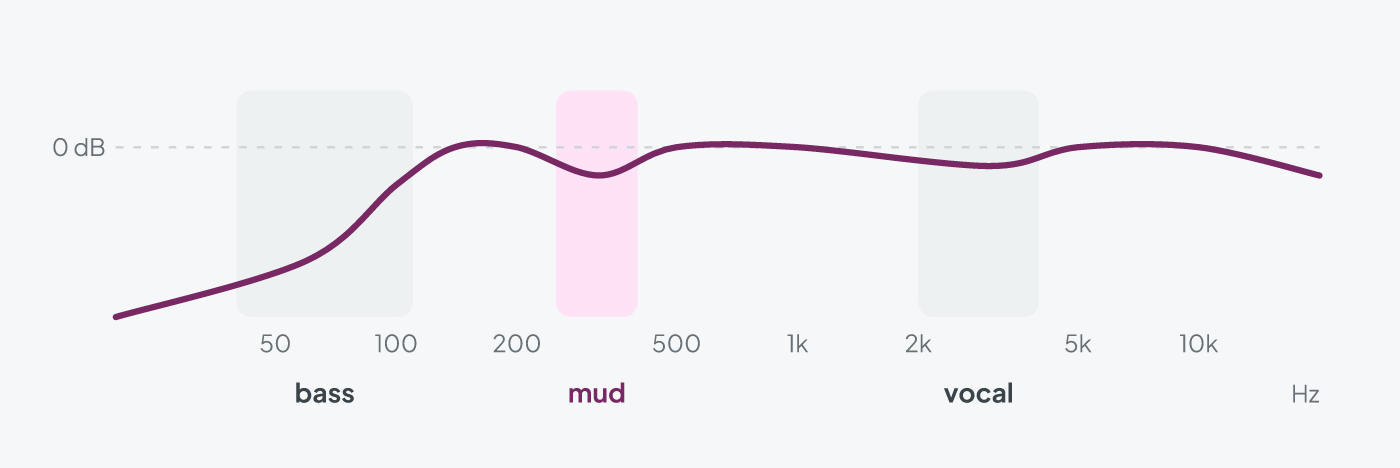
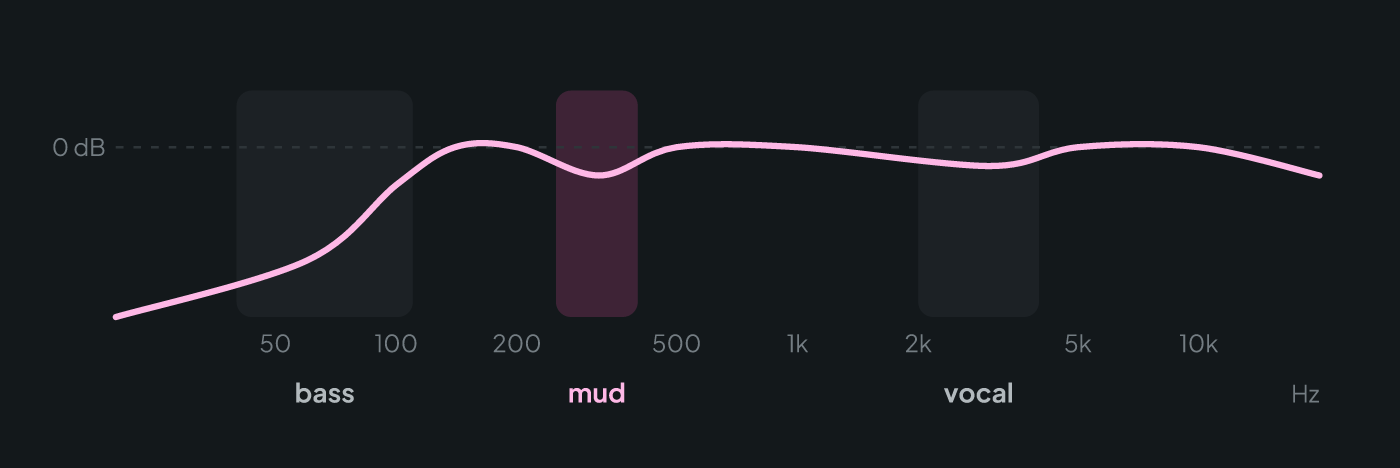
You can hear the clash in the mix, too. A starting EQ for keys with a full band:
How should your voicing change from section to section?
Keys dynamics aren’t just volume: they’re how many notes you play and where.
| Section | Right hand | Left hand (with bass) | Rhythm |
|---|---|---|---|
| Intro / verse 1 | 2-3 notes, sus2, middle register | Out | Long or whole notes |
| Verse 2 | Triad inversions | One sustained note | Soft quarter notes |
| Chorus | Open triads, higher up | Fifth or root in the middle | Follow the drums |
| Bridge | Start sparse and climb in register | Comes in as it builds | Builds with the band |
| Final chorus | An octave higher, add9 | Mid-register support | Full, but off the bass |
The bridge is where it shows most: start with two notes and move up a register every four bars, and the song grows without the sound tech touching a fader. If there’s a harmony singer, look at how the parts are split in vocal harmonies: when a harmony comes in, the keys can drop the note it’s doubling.
Common mistakes
- Low left-hand octaves with a bassist in the room. The most common mistake, and the one that muddies the mix the most.
- Root-position chords all the time. Your hand jumps, the register shifts on every chord and the band loses the thread.
- Playing in the same range with the same rhythm as the guitar. Two instruments doing the same thing sound like one worse instrument.
- Doubling the melody with your top note. It competes with the vocal and exposes any pitch difference.
- Loading every chord with tensions. One added 2 gives you the color; five notes give you mud.
- Playing the verse like the chorus. If the keys are already full in verse one, the chorus has nowhere to go.
Frequently asked questions
What should the left hand play when there's a bass player?
Very little in the low register. Below C3 (the C an octave below middle C) is the bass player's territory, and if the keys double those notes the low end gets muddy and the sound tech has to cut it anyway. With a bassist, the left hand either sits out, holds a single long note in the middle register, or shares the chord with the right hand. Without a bassist, yes: the left hand becomes the bass, playing roots or octaves.
What's an inversion, and why do worship keys players use them so much?
An inversion is the same chord with a different note on the bottom: G major can be G-B-D, B-D-G or D-G-B. Keys players use them so the right hand doesn't jump around: if you pick the inversion that shares notes with the previous chord, only one or two notes move, by a whole or half step. It sounds smoother, leaves more room for the vocal, and it's much easier to play.
How do I keep from clashing with the acoustic guitar?
Split the register and the job. If the guitar is strumming full chords in the middle register, move up an octave (C4 to C6), play fewer notes, or switch to a pad or sustained notes. If the guitar is picking or drops out, the keys can fill the middle again. Both instruments strumming the same chords in the same range is the most common reason a band sounds muddy.