Bass in worship: what to play and when to lay out
The bass on a worship team, section by section: the root, when to come in, staying clear of the keys and the kick, and getting it to the desk through a DI.
In this article8 sections
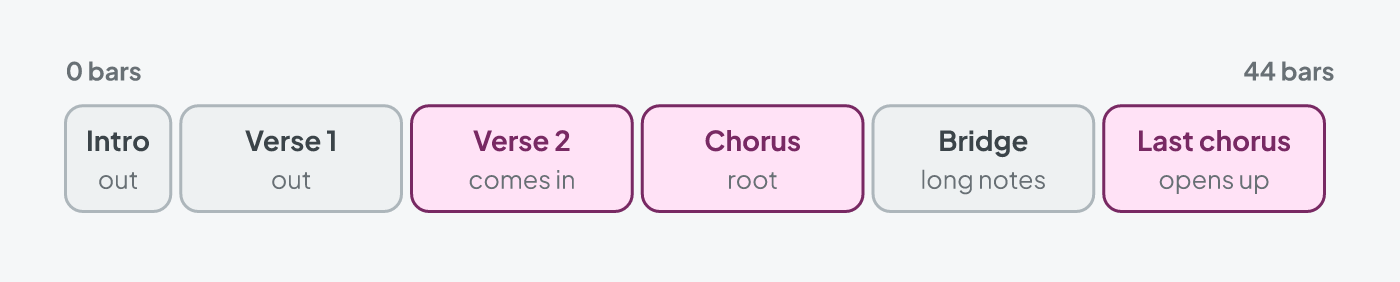
Short answer: the bass is the bridge between harmony and rhythm: it plays the root of each chord, together with the kick drum, and that alone makes the whole band sound together. Three decisions do most of the work: come in late (second verse or first chorus) so the song grows without getting louder, don’t double the keyboard’s left hand or the pad’s low end, and send it to the desk through a DI with a high-pass filter around 30-40 Hz. Embellishments come last, once the basics don’t move.
The bass is the instrument you notice least when it’s right and most when it’s missing. A congregation couldn’t tell you what it does, but they notice that “it sounded fuller last Sunday.” This guide is about bass on an ordinary worship team: a small band, congregational songs and a room that doesn’t always help with the low end.
What does the bass do on a worship team?
Two jobs at once, which is why it’s hard:
- Harmonic: it defines the chord from below. A C chord with C in the bass sounds like C; the same chord with E in the bass sounds like something else (C/E), and in a lot of worship songs those inversions are part of the arrangement.
- Rhythmic: together with the kick, it marks where the strong beat lands. When bass and kick line up, the band sounds “locked in” even if each plays very little.
That gives you the rule that sums it all up: the root, on the strong beat, with the kick. Everything else is decoration, and decoration is earned later.
What do I play in each section of the song?
| Section | What works | What to avoid |
|---|---|---|
| Intro | Silence, or one long note if the pad leaves room | Coming in with the full groove from bar one |
| Verse 1 | Nothing, or long notes on one | Busy lines: the verse belongs to the lyric |
| Verse 2 | Root with the kick, quarter or half notes | Doubling the snare rhythm |
| Chorus | A clear root, octaves if the song wants energy | Passing notes on every chord change |
| Bridge | Pull back: long notes or a pedal on one note | Staying the same as the chorus |
| Final chorus | More movement, the odd connecting fill | Filling every bar |
How do I stay out of the way of the keys and pads?
The most common clash on a worship team isn’t with the guitar, it’s with the keyboard player’s left hand. A pianist used to playing alone puts low octaves under every chord, and with a bass on top, the low end turns to mud.
- Agree with the keys player: when the bass comes in, the left hand moves up (chords in the middle octave) or drops out.
- Pads: many pads carry their own low end. If there’s a bass, ask the engineer for a high-pass filter on the pad, or choose more open pads.
- Tracks: if the backing track has bass, the bassist doesn’t play over it, or the bass stem gets muted. Two basses never line up perfectly.
- Inversions: if the chart says C/E, the bass plays the E. The keys playing it too in the left hand is fine; the keys playing C is not.
How does the bass fit with the kick drum?
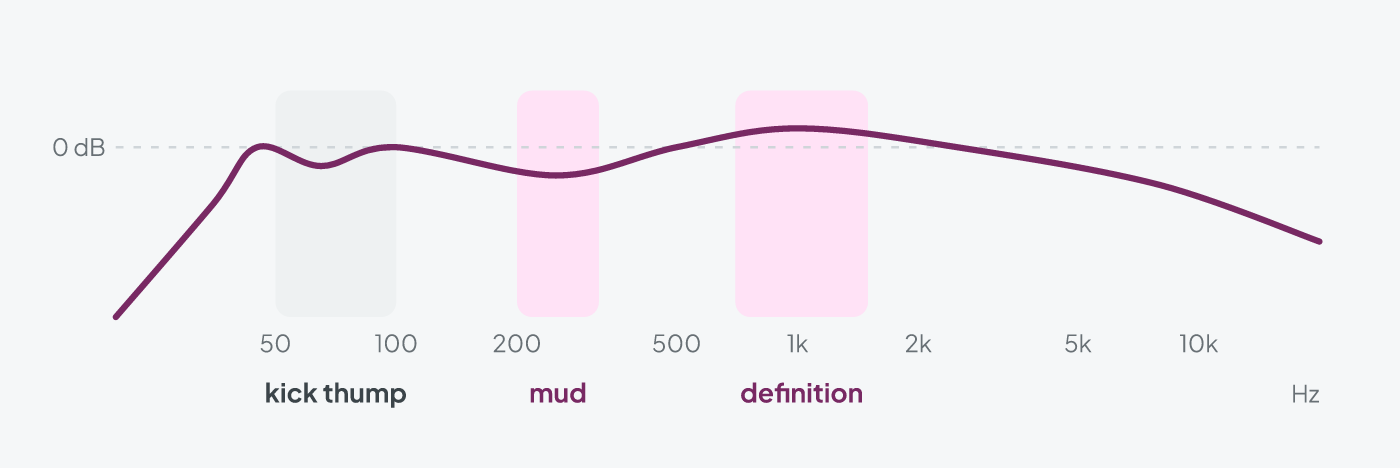
In frequency terms, bass and kick share the same floor. The kick has its thump between 50 and 100 Hz and the beater attack above 2 kHz; the bass has its fundamental between 41 Hz (low E) and around 400 Hz, and note definition between 700 Hz and 1.5 kHz. If both fight over the same 60 Hz, the engineer has to decide who owns the bottom and carve room for the other.
On the playing side, locking in is simpler than it sounds: watch or listen to the kick and play the root where it lands. If the drummer plays the kick on one and three, you play on one and three. We cover how to rehearse that lock in the guide to bass and drums as a section.
How do I get the bass to the desk?
Through a DI box, always. The bass comes out on a jack (high-impedance, unbalanced signal) and the desk wants balanced XLR; the DI does that conversion and lets you run long cables without noise.
- Passive bass (no battery): an active DI, which doesn’t load the signal.
- Active bass (battery and preamp): a passive DI is enough.
- With an amp: many bass amps have an XLR out. Send that to the desk and keep the amp as the bassist’s monitor, at low volume: in a small room, a loud bass amp is already more low end than the PA.
- No amp (silent stage): DI to the desk and the bassist hears themselves through in-ears or a wedge. It’s the cleanest option if you already have in-ears.
At the desk: a high-pass filter around 30-40 Hz, some gentle compression to even out notes and, if the room has a resonant mode (one note that booms more than the others), a narrow cut at that frequency.
Four strings or five?
For worship, four strings are almost always enough. The fifth low B (around 31 Hz) is useful in the low keys of modern worship —a low D or C with more weight— but in a small room those notes get lost or boom. If you already have a five-string, use it to play in more comfortable positions, not to go lower.
Common bass mistakes in worship
- Playing from the first bar of every song. It burns the best growth tool the band has.
- Filling every chord change. Constant passing notes move the floor the congregation needs to stay still.
- Ignoring the kick. A well-played bass line that doesn’t line up with the kick sounds “loose” even when every note is right.
- Doubling the low end of the keys or the track. The result is mud, and in a small room mud is what you hear most.
- Turning up the amp to hear yourself. A bass amp on stage is the source of low end the engineer can’t control.
Frequently asked questions
What should the bass play in a worship song?
Mostly the root of each chord, on the strong beat, with long notes when the song is slow. The bass ties harmony to rhythm: if it plays the root with the kick drum, the whole band sounds together. Embellishments (passing notes, octaves, syncopated rhythms) are saved for the last chorus or to connect sections, and always after the basics are solid.
When should the bass come in?
Usually not from the first bar. Bringing the bass in on the second verse or the first chorus is one of the strongest growth tools a small band has: the song suddenly gets a floor without anyone turning up. What matters is agreeing on it and writing it on the setlist so it doesn't depend on the mood of the day.
How do you connect a bass to the sound desk?
Through a DI box: the bass goes in on a jack and comes out on balanced XLR to the desk. If the bass is passive, an active DI is better; if it's active, a passive DI will do. If the bassist uses an amp, many DIs and amps have an XLR out to send the signal to the desk and use the amp only as a monitor, at low volume. At the desk, a high-pass filter around 30-40 Hz removes what you can't hear but still takes up space.