Bass with backing tracks: when to play and when to mute the track
How a bassist lives with backing tracks: who plays bass in each song, how to split it with the track and the keys, and what to do when the track fails.
In this article7 sections
Short answer: with backing tracks, the rule is one bass per song: either the bassist plays it or the track does, never both at once. Most common is to mute the bass stem and play live, keeping the stem only on songs or sections where the arrangement calls for it. The bassist needs click and the leader’s vocal in their in-ear, because the track waits for nobody, and has to know the whole song to carry on if the track fails.
Backing tracks solve a lot for a small team: pads, strings, percussion, sometimes the second guitar. But almost every track you buy also includes bass, and that’s where the bassist’s problem starts: play over it, sit out, or mute the stem? This guide is about deciding it song by song.
Why can’t two basses play at once?
Because they never line up. The bass stem has its own notes, articulation and feel; the bassist has theirs. Even if both play the same roots, a longer note here and a different attack there turn the low end to mud, and in a small room mud is what you hear most.
So the decision isn’t “how do I play with the bass stem,” it’s who plays bass on this song.
Who plays bass on each song?
| Situation | Who plays | How |
|---|---|---|
| There’s a bassist and the song is congregational | The bassist | Bass stem muted in the app |
| Arrangement built on a prominent synth bass | The track | The bassist rests or doubles only in the last chorus |
| Slow song with a pad | The bassist, late | Bass stem muted; the bassist comes in on verse two |
| No bassist this Sunday | The track | And the keys player with no low left hand |
| Spontaneous moment or no click | The bassist | The track is stopped; nobody else holds the low end |
What matters is that the decision is written on each service’s setlist, not improvised at soundcheck.
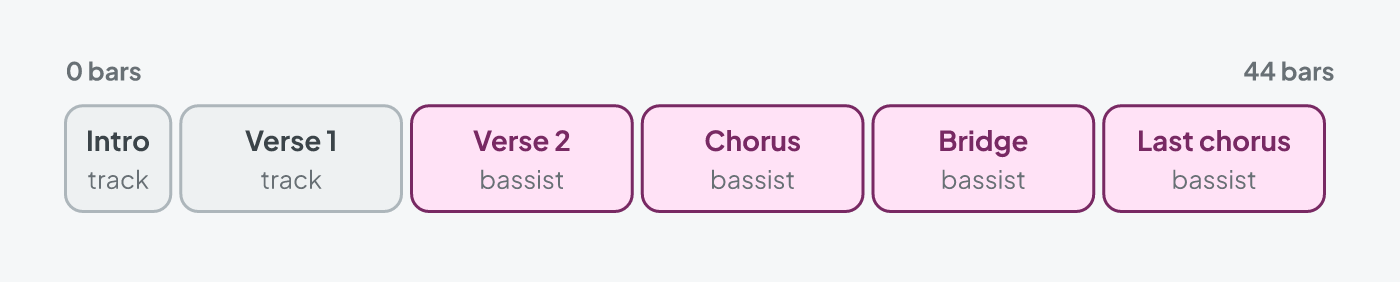

How do you split it with the track and the keys?
With tracks there are three possible sources of low end: the bass stem, the keyboard’s left hand and the bassist. The rule from the bass guide extends: at any moment, only one.
- Bass stem: mute it in the tracks app (almost all of them let you turn off each stem per song and save the setting).
- Keys: no low octaves when the bass is playing; if the track has piano, the keys player plays something else or mutes it too.
- Pads: many carry their own low end. A high-pass on the pad channel leaves room for the bass.
What does the bassist need to hear?
The track waits for nobody. If the bassist can’t hear the click, they’ll be half a step behind or ahead of something that doesn’t move. In their in-ear:
- Click, clear but not loud.
- The leader’s vocal, for structure changes.
- The kick drum, the other half of the section.
- Whatever the track is playing, so they don’t step on it.
- Their own bass, above everything else.
What happens if the track fails?
It will fail some Sunday: a laptop freezes, a cable comes loose, the leader decides to repeat a song. The band has to be able to carry on:
- Know the whole song, even if the track plays parts. If the bassist relies on the track to know when the bridge comes, when the track stops, the song stops.
- An agreed signal from the leader to continue without the track.
- Bass and drums hold it. When the track fails, the rhythm section is what keeps the congregation singing.
- The bassist covers whatever the track was carrying, simply: the root is enough.
Common bassist mistakes with tracks
- Playing over the bass stem. The most common mistake and the one that makes the most mud.
- Playing without a click. With a track that doesn’t move, any drift is audible.
- Deciding it at soundcheck. Without a written decision, the same argument happens every Sunday.
- Relying on the track for the structure. The day it fails, the bassist gets lost with it.
- Forgetting the keyboard’s left hand. Three low ends at once: track, keys and bass.
Frequently asked questions
What do I do if the backing track already has bass?
Pick one of the two per song. The most common choice is to mute the bass stem in the app and play it live; the alternative is to keep the stem and have the bassist sit out, or play only in sections where the track goes quiet. What doesn't work is playing over a bass stem: two basses never line up perfectly and the low end turns to mud.
Does the bassist need to hear the click if there are tracks?
Yes. With tracks, the track waits for nobody: if the bassist can't hear the click, they'll be half a step behind or ahead of something that doesn't move. The minimum is click and the leader's vocal in the in-ear; better if they also get the kick drum and whatever the track is playing.
What happens if the track fails mid-song?
The band has to be able to carry on without it. That means bass and drums need to know the whole song even if the track plays parts, and the leader needs an agreed signal for continuing without the track. If the bass relies on the track to know the structure, when the track stops, the song stops.