Drums in a small church: acoustic, electronic or cajón
Acoustic kit, electronic kit or cajón in a small room: volume, cost, what the desk needs, and how to play so the drums help without burying the congregation.
In this article8 sections
Short answer: in a small church the drum problem isn’t tone, it’s volume: an acoustic kit played normally is louder than everything else combined and forces the rest of the band up. There are three paths: cajón (cheap, soft, ideal in rooms under a hundred people), a tamed acoustic kit (rods, thin cymbals, a shield and a drummer who plays to the room) and electronic (volume controlled from the desk, but it requires in-ears or a good monitor). Choose by the room and the monitoring you already have, not by the kit you like.
Almost every sound problem in a small church starts in the same place: an acoustic drum kit in a room designed for the spoken word. The engineer pushes the vocals to hear them over it, then pushes the keys to hear them over the vocals, and by the third song everyone is playing louder than the room can handle. This guide isn’t about which brand to buy; it’s about which path fits your room and your team, and how to play on it.
Why do the drums set the volume for everything?
Because they’re the only instrument that doesn’t go through the desk. Guitar, keys and vocals are as loud as the engineer wants; an acoustic kit is as loud as it’s played, and in a small room that’s already more than the mix needs. A snare played normally, a few meters away, is in the 100 dB range or above, and cymbals bounce off any low ceiling.
The result is the usual loop: the engineer can’t turn the drums down, so they turn everything else up, and the congregation —the main instrument— gets buried. The goal isn’t a quieter drum kit for its own sake: it’s a drum kit that leaves the mix in the engineer’s hands.
Acoustic, electronic or cajón?
| Cajón | Tamed acoustic | Electronic | |
|---|---|---|---|
| Volume in the room | Low | Medium, depends on the player | Whatever the desk decides |
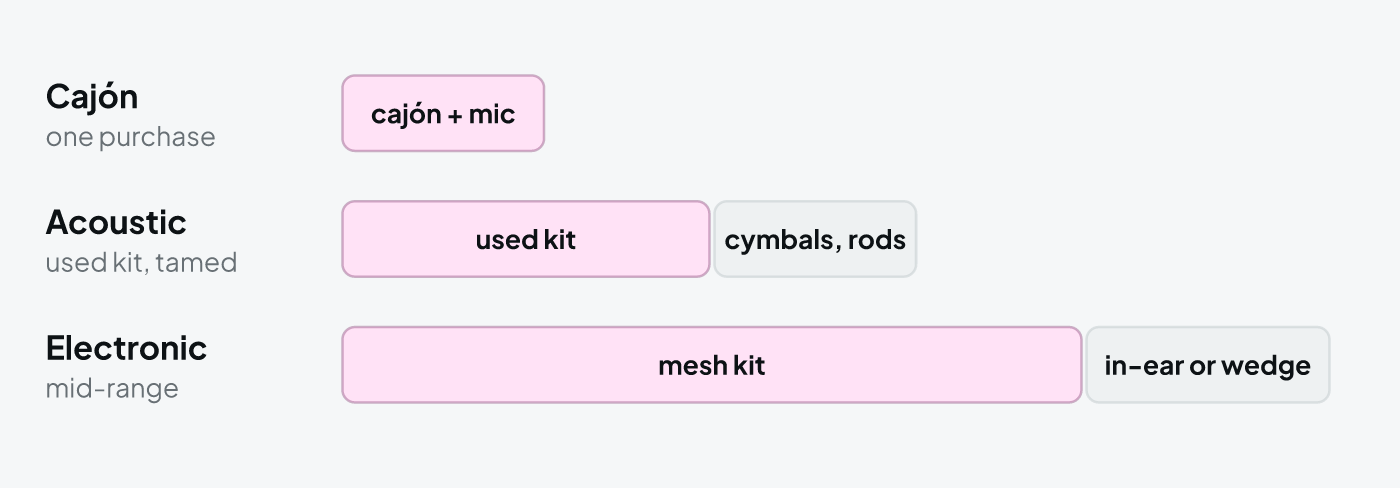
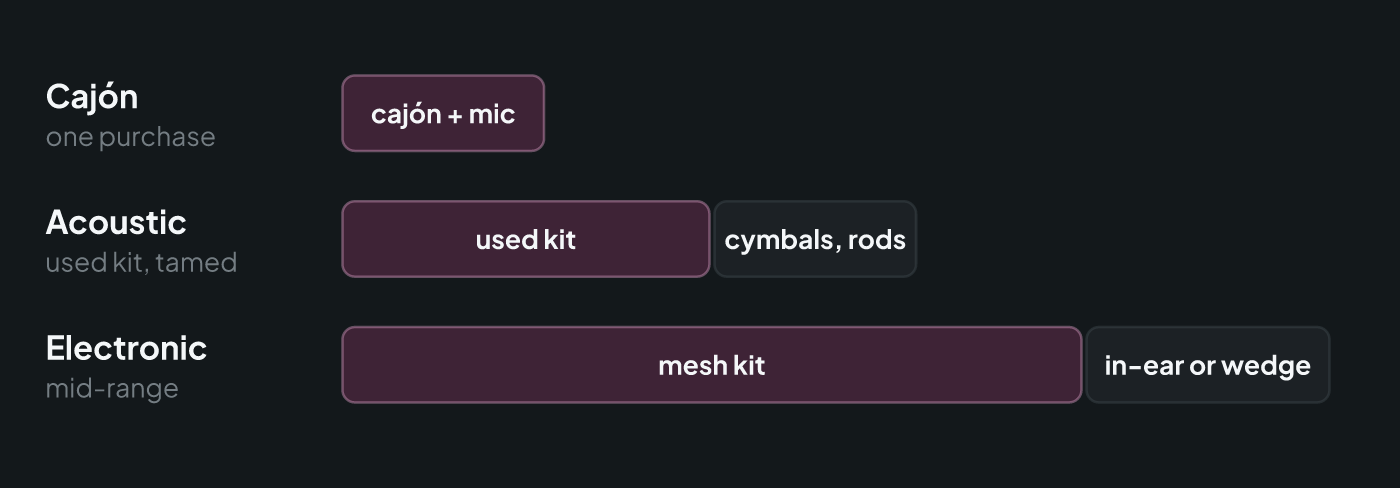
| Rough cost | €80-250 | €300-800 (used kit + rods, thin cymbals) | €500-1,500 for the kit, plus monitoring |
| Feel for the drummer | Very good, different language | The best | Fine with mesh heads; needs a monitor |
| What it needs from the desk | 1 mic (or none in very small rooms) | 2-4 mics in a mid-sized room | 1-2 line inputs |
| Where it shines | Rooms under 100, acoustic sets, small groups | Mid-sized rooms with a controlled drummer | Very live rooms, teams on in-ears |
| Where it fails | High-energy songs | Drummers who only know how to play loud | Teams with no stage monitoring |
Reading the table backwards gives you the practical rule: if you have no in-ears and no decent monitors, electronic drums are a trap, because the drummer can’t hear themselves and the band loses the pulse. And if the room is small and the setlist is calm, a well-played cajón does more for the service than the best kit.
When is a cajón enough?
More often than people think. A cajón gives pulse and accent —which is what a congregation needs to sing together— without the volume of cymbals. It shines in:
- Small rooms or rooms with low ceilings, where any cymbal is too much.
- Acoustic services or calm setlists: hymns, slow songs, prayer times.
- Teams that are starting out, with a percussionist who isn’t yet comfortable on a full kit.
To get the most out of a cajón: one mic inside or behind (at the port) for the low end and another in front if the room needs it; brushes for slow songs, and a shaker or tambourine on the more energetic ones, so you have some top end without cymbals. It falls short on high-energy modern worship, where you miss the kick drum and an open cymbal in the chorus.
How do you tame an acoustic kit?
Before buying anything, change how it’s played. An acoustic kit played for the room, not for a rehearsal space, fits in almost any church. In order of impact:
- Rods on calm and mid-tempo songs. They cut snare and cymbal volume a lot without changing the instrument.
- Thinner, smaller cymbals. A heavy ride and an 18” crash are the first to fill the room; a thin 16” crash dies away sooner.
- Heads and damping. Two-ply heads, a damping ring on the snare and a blanket inside the kick cut resonance and volume.
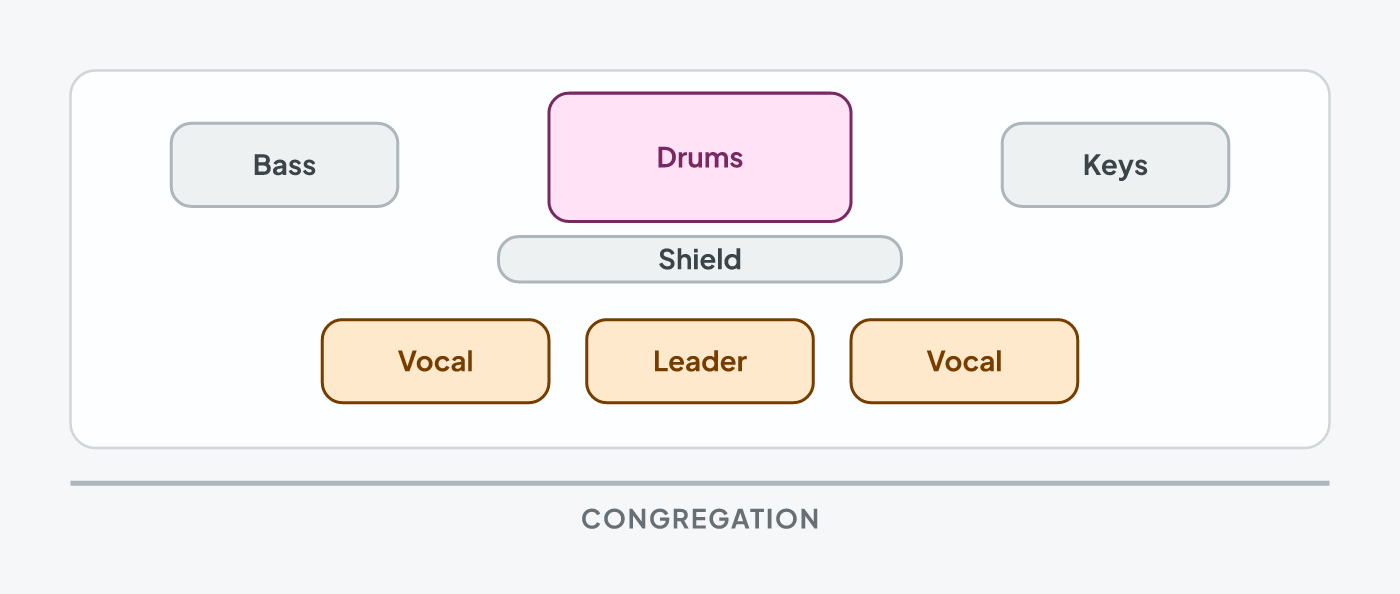
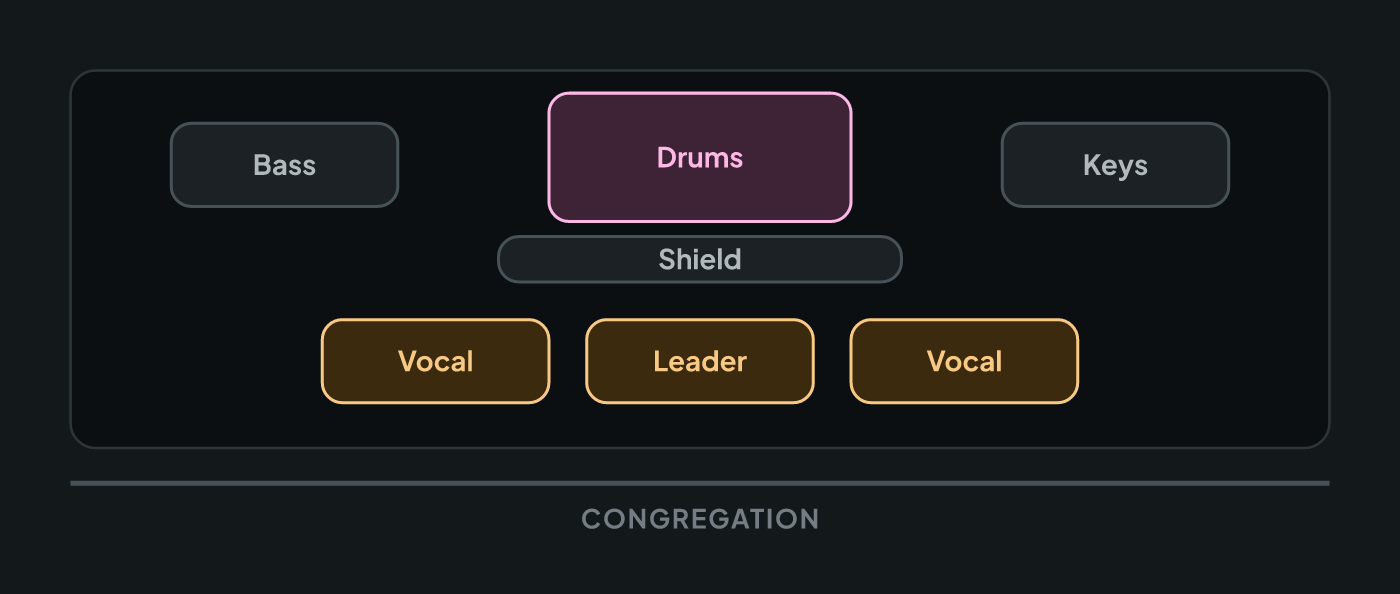
- A front shield. It cuts cymbals and snare toward the congregation and the vocal mics. It helps, but it isn’t magic: the kick and the ceiling reflections are still there.
- Playing to the room. The cheapest change and the hardest one: real dynamics, a medium snare stroke, cymbals only where the song grows.
What does an electronic kit need to work?
An electronic kit solves volume at the root: everything you hear comes out of the desk, so the engineer can place it wherever the mix needs it. But it has three requirements worth budgeting from the start:
- Monitoring for the drummer. An in-ear or, at the very least, a drum monitor or closed-back headphones. Without that, they play blind.
- Monitoring for the band. On an acoustic stage, the band hears the drums in the air; with an electronic kit, they only hear it if you send it to their wedges or in-ears.
- A good sound, chosen carefully. Factory kits are often designed to impress in the store: lots of reverb, lots of low end. For a service, a dry, natural kit, with the reverb added at the desk.
What stays the same: entry-level hi-hat and kick pedals are the first thing to fail. If you need to save money, save on the sound module, not on pedals or mesh heads.
What do the drums play in a worship song?
Whichever path you choose, drums in a service have a simple, demanding job: hold the pulse so a whole room sings together and grow the song section by section.
- Verse: not much. Closed hi-hat or cross-stick, kick on one. Sometimes nothing: drums coming in on the second verse is already growth.
- Chorus: the full groove, clear kick and snare, a cymbal on the first beat of the chorus.
- Bridge: often pulls back again, to rise into the last chorus.
- Ending: agreed in advance. A loose drum ending leaves the congregation unsure whether the song is over.
Fills should be short and serve the transition. The congregation doesn’t know what a fill is, but it does notice when the tempo drifts, and the drums are what hold it.
Common drum mistakes in a small room
- Buying an electronic kit without thinking about monitoring. The volume drops, but the band stops hearing the pulse and the tempo starts to drift.
- Relying on the shield for what the hands should do. A kit played hard behind acrylic still sounds loud.
- Rock cymbals in a fifty-person room. They’re what fills the room most and the easiest thing to change.
- Miking the whole kit because “that’s how it’s done.” In a small room, an acoustic kit is often plenty loud without mics; at most, the kick.
- Playing every song at the same intensity. Without dynamics, drums flatten the setlist just like a guitar that always strums at full force.
Frequently asked questions
What kind of drums work best in a small church?
It depends on two things: the size of the room and whether the team has a digital desk and in-ears. In rooms under a hundred people with no monitor control, a cajón (or an acoustic kit played very softly with rods) usually works better than a full kit. If you already have a digital desk and in-ears, a mid-range electronic kit solves the volume problem at the root, because everything you hear goes through the desk.
Do electronic drums sound worse than acoustic ones?
They sound different. A mid-range electronic kit with good mesh heads and a well-chosen sound sits very well in a service mix, with the advantage that the engineer controls the whole volume. What you lose is feel on stage: without a good monitor, the drummer plays blind and the rest of the band loses its reference. Always budget the monitoring together with the kit.
Does a drum shield actually reduce volume?
It helps, but less than people expect. A front acrylic shield mostly cuts the highs (cymbals and snare) heading toward the congregation and into the vocal mics, but the kick and the ceiling reflections are still there. It works well combined with rods, thinner cymbals and a drummer who plays to the room; on its own it's rarely enough.